Tuesday, January 5, 2010
How do you rescue a stranded worker, such as a window washer, who is high above the ground and unable to help himself? You call in firefighters trained in high-angle rope rescue. Hillsboro Fire and Rescue has been conducting high angle rope rescue drills this week at the 5-story public parking garage at First and Washington Streets. The firefighters practiced setting the rigging and executing the rescue of a practice dummy from the side of the parking structure.
Tuesday’s drill allowed Hillsboro Fire Department's veteran rope rescue technicians to teach newer firefighters techniques for handing the ropes and for being the rescuer. Often the most difficult part of a high angle rescue is getting over the edge without suffering an injury. In this drill, firefighters used a tripod to elevate the point from which the rescuer is lowered allowing a easier and safer move over the edge. Once the firefighter reached the “patient,” he moved the patient from the patient's rigging to the rescue rigging and lowered the patient to the next garage level down to be unhooked. Firefighters drill regularly on skills that are high risk/low frequency to ensure that they can be done quickly and safely.


Winter Heating Safety
 |
| From Winter Heating Safety |
Post holiday bills and high heating costs sometimes drive citizens to heat their homes with alternative sources. This time of year we see a spike in home heating fires caused by wood burning stoves, fireplaces and space heaters. You can reduce your chances of a heating-related fire by following these tips:
- Ensure space heaters are kept at least three feet away from anything that can burn. They should also have a tip-over shutoff switch.
- Have chimneys professionally inspected and cleaned each year.
- Dispose of fireplace and wood stove ashes in a metal container–never use a paper bag or cardboard box.
- Use a glass or metal screen in front of the fireplace to prevent sparks from igniting drapes, furniture and carpets.
- Ensure wood stoves are properly installed.
- Never use a range or oven to heat your home.
And, we can never mention it enough -- ensure you have a working smoke alarm on each level of your home, outside sleeping areas and, for maximum protection, one in each bedroom!
Wednesday, December 23, 2009
Visible Signs of Progress - New Fire Station
 |
| From New Fire Station 6 |
There is visible evidence of progress on the construction of Hillsboro Fire Department’s new fire station located at 21880 NW Cherry Lane. The contractor, CSI Construction of Portland, has begun site work in preparation for laying a foundation for the 16,000-square foot building that will house an engine company and the Department’s training division.
The addition of this facility is part of the Fire Department’s Strategic Plan that City Council approved to address response times. Our goal is to reach your emergency within four minutes of leaving our station 75% of the time. The need to arrive at fires quickly is obvious—to stop the progression of a fire before it destroys more of your property. The majority of our calls are medical in nature and rapid access of the patient is essential to deliver life-saving medical treatment in the field, as well.
The new fire station is designed to achieve a LEED Gold Certification when completed. The LEED Program (Leadership in Energy and Environmental Design) is an internationally recognized green building rating system providing a suite of standards for environmentally sustainable construction. Building to this standard offers many benefits:
1. The construction process focuses on locally produced and/or locally sourced materials
2. Consumes fewer resources and generates fewer greenhouse gas emissions
3. Will be energy efficient, requiring less electricity and water to operate
The completion of the construction project is slated for July 2010.
Tuesday, November 17, 2009
Safety on the Fire Ground
 |
| Mittendorf Truck Ops |
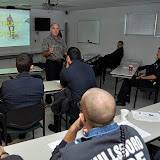
Veteran fire ground commander and author John Mittendorf came to Hillsboro Fire Department to provide our firefighters a new perspective on safety. The retired Los Angeles City Fire Department Battalion Chief talked at length this week with our firefighters about changes necessary to avoid unnecessary risks when fighting structure fires. Mittendorf has examined the tasks responsible for the annual loss of over 100 firefighters across the country each year and offered ways to avoid those fatalities.
Citing the deaths of nine firefighters in the South Carolina Sofa Super Store fire in 2007 and the six who perished in the 1999 Worchester, Massachusetts, warehouse fire, Mittendorf discussed critical decisions that all incident commanders must make and where their priorities should be placed. The priorities always start with life safety.
The presentation also looked at apparatus placement at single family residential fires and at multi-story residential and commercial buildings to provide for the maximum use of the aerial ladder aboard the truck. Those placements may be different based on the circumstances.
We are grateful for the knowledge that Retired Chief Mittendorf has shared. We hope that his sharing of his experiences and wisdom will make our firefighters better and safer in the days ahead.
Tuesday, October 27, 2009
Standpipe Operations
Picture a fire in a multistory building and the stairwell is already compromised by the blaze. How do you get firefighters into the upper stories to fight it? With a ladder, of course! But the task is complicated by having to bring hose along with you to fight the fire. That’s why Hillsboro firefighters this past week have been drilling on what’s called “standpipe operations.”
Standpipes are normally water pipes built into multi-story buildings to help supply firefighting water to the upper stories. In cases where they are installed in buildings or parking structures, firefighters bring hose bundles with them and attach to the pipes. The pipes are either fed by the municipal water supply or by the fire engine attaching to an “FDC” or fire department connection on the exterior of the building. Once attached to the standpipe, they can charge their hoses and advance on the fire.
In multi-story buildings where there are no standpipes, firefighters have to essentially create their own by bringing a larger diameter hose up the ladder to their floor of entry, attaching a gated “Y” valve to split the larger line into two smaller attack lines for maneuverability, and advancing to the fire’s location. The process is not complicated, but requires several critical steps to ensure a smooth fire attack, one of which includes securing the larger diameter hose to the ladder to ensure it doesn’t fall and pull the smaller lines down with it when the lines are charged with water.
Standpipes are normally water pipes built into multi-story buildings to help supply firefighting water to the upper stories. In cases where they are installed in buildings or parking structures, firefighters bring hose bundles with them and attach to the pipes. The pipes are either fed by the municipal water supply or by the fire engine attaching to an “FDC” or fire department connection on the exterior of the building. Once attached to the standpipe, they can charge their hoses and advance on the fire.
In multi-story buildings where there are no standpipes, firefighters have to essentially create their own by bringing a larger diameter hose up the ladder to their floor of entry, attaching a gated “Y” valve to split the larger line into two smaller attack lines for maneuverability, and advancing to the fire’s location. The process is not complicated, but requires several critical steps to ensure a smooth fire attack, one of which includes securing the larger diameter hose to the ladder to ensure it doesn’t fall and pull the smaller lines down with it when the lines are charged with water.
Wednesday, October 7, 2009
Firefighters Are People, Too!
 |
| CISM Training by Chaplain Brodehl |
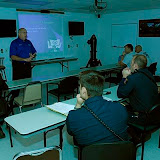
Despite their image of America’s bravest, firefighters are human and subject to the emotional toll of seeing tragic and horrific events, sometimes on a daily basis. To ensure they don’t suffer long-term stress-related illness, Hillsboro Fire and Rescue provided training this week about Critical Incident Stress Management (CISM).
Hillsboro Fire Chaplain Steve Brodehl provided the program that showed the old philosophy of “just deal with it” often resulted in emotional problems, family discord and addictions. Those add up to an untimely end to a promising career. Today’s concept of CISM is to “talk it out.” That means to discuss with fellow crew members the impact a particularly tragic call had. It could be that the child injured or killed looked like or was the same age as the firefighter’s own children that prompted the emotional impact. Whatever the reason, an open discussion around the dinner table after the call goes a long way toward alleviating the emotional impact a bad call has had.
Company officers can also organize an informal Defusing session within a few hours of the incident to help facilitate the frank and open discussion of the toll a tragic call has taken. These sessions are voluntary.
If more than a couple of crew members are still feeling impacted by a call for more than a day or two, a closed-session Debriefing can be ordered by the Chief. Attendance is mandatory. This session is led by a facilitator from outside the department who may be aided by chaplains, also from outside the department.
HFD invests heavily in training firefighters to provide the best possible service for our citizens. We want to ensure the firefighters retire mentally and physically healthy and capable of continuing to invest in their families and our community after their career as a firefighter ends.
Monday, October 5, 2009
Fire Prevention Week Open House
Hillsboro Fire and Rescue kicked off National Fire Prevention Week with an open house at Fire Station 1 on Saturday, October 3rd. More than 300 people showed up to pick up safety information, tour the station, climb aboard fire engines, play games, and see demonstrations. Kids particularly liked the miniature fire engine built by HFD Engineer Mike Banta. There was a line most of the day waiting to crawl into the tiny cab and blow the siren. Take a look at our photos of the event.
Fire Prevention Week is organized each year to bring awareness to the most serious fire safety issues. This year's theme: Stay Fire Smart! Don't Get Burned. It points out the simple yet necessary habits to avoid tradegies: Test the bath water before putting a baby in it; use short or close-fitting sleeves when cooking on the stove top; set your hot water heater to no more than 120-degrees(F); and have a three-foot kid-free zone around your stove.
Additionally, this year's focus included adult burn prevention. One of the most common and preventable severe burns in Oregon is adult males using gasoline to start burn piles, barbeques or cleaning car parts. The unexpected explosion that occurs when an ignition source, such as a lit match, finds accumulating gas fumes has sent many men to the area's burn center. Please avoid using gasoline for anything other than a fuel for motorized equipment and vehicles.
Fire Prevention Week is organized each year to bring awareness to the most serious fire safety issues. This year's theme: Stay Fire Smart! Don't Get Burned. It points out the simple yet necessary habits to avoid tradegies: Test the bath water before putting a baby in it; use short or close-fitting sleeves when cooking on the stove top; set your hot water heater to no more than 120-degrees(F); and have a three-foot kid-free zone around your stove.
Additionally, this year's focus included adult burn prevention. One of the most common and preventable severe burns in Oregon is adult males using gasoline to start burn piles, barbeques or cleaning car parts. The unexpected explosion that occurs when an ignition source, such as a lit match, finds accumulating gas fumes has sent many men to the area's burn center. Please avoid using gasoline for anything other than a fuel for motorized equipment and vehicles.
Subscribe to:
Posts (Atom)
